In June 2023, I published a video.
The subject was Bryan Johnson — Silicon Valley billionaire, widely celebrated at the time as "the world's foremost anti-aging pioneer."
He assembled a team of 30 specialists.
He invested two million dollars a year.
He took over a hundred supplements daily.

He woke at 4:30 every morning and was asleep by 8:30 every night, without exception.
He had turned himself into a precisely calibrated biological machine.
The title of that video was: "Does What You Eat Matter More Than Happiness? Here's Why a Silicon Valley Billionaire's Anti-Aging Mission Is Destined to Fail."
My conclusion was simple:
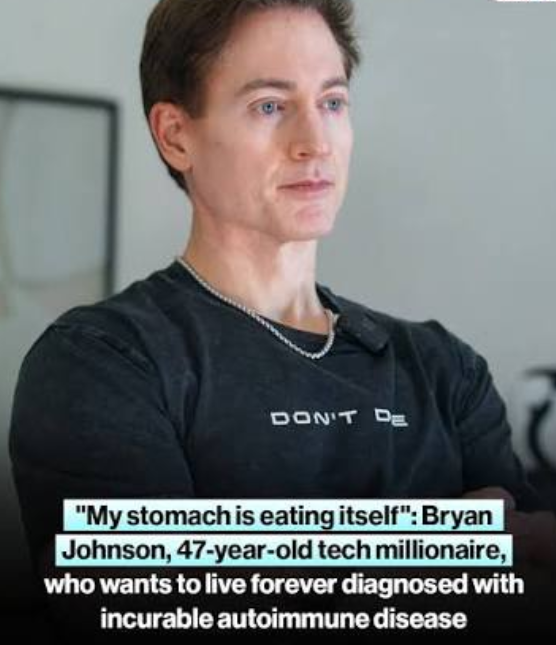
Last week, he publicly announced a diagnosis of Autoimmune Gastritis (AIG).

What I Said Three Years Ago
In that video, I offered three reasons for my prediction:
First, aging is a multi-mechanism complex system. Controlling external variables — diet, sleep, exercise, testing — is insufficient to intervene in all the internal mechanisms that drive aging. Some risks are created by the interventions themselves.
Second, some variables can never be controlled. Accidents, luck, the stochastic expression of genes, the breakdown of coordination between the body's internal systems — none of these appear on his meticulous management checklist.
Third, extreme control itself generates fragility. Research consistently shows that people who exercise excessive self-control are more prone to systemic collapse than those who practice moderate self-regulation. Compressing life into metrics means drawing on the system's reserves of elasticity — and elasticity, as it turns out, is one of the core assets of genuine longevity.
The Way He Failed Is More Ironic Than I Expected
I assumed he would fall to some external variable: an accident, an infectious disease, the accumulated side effects of one supplement or another.
But reality chose something far more metaphorically resonant.
Autoimmune gastritis is not an invasion from outside.
He controlled virtually every external variable he could identify. What he could not control was the breakdown of coordination within the internal systems of his own body.
In other words: he was not defeated by aging.
The medical term for this is autoimmunity — the system attacking itself.
To me, this is also a near-perfect metaphor for his entire methodology.
Why Extreme Control Produces Internal Breakdown
There is a more fundamental problem here — not simply that he controlled too much.
Bryan Johnson's basic assumption about his own body was wrong from the beginning.
The machine logic goes like this: identify all the variables that affect the outcome, control each one, optimize everything to peak performance, and the results will be predictable and reproducible.
The critical difference between a CAS and a machine is this: in a CAS,
Bryan Johnson controlled dozens of variables: every calorie of food, every minute of sleep, every heart-rate zone of exercise, every biomarker in his blood.
But what he never controlled — and could never control — was
How does his precisely engineered diet affect immune regulation? How does an extremely rigid sleep schedule influence cortisol rhythms over years? How does a highly structured, friction-free life affect the adaptability of his nervous system? What emerges from the combined interaction of all these optimized subsystems?
These are questions that modern science does not yet fully understand.
He believed he was controlling the system.
And the system answered him with an autoimmune disease.
Here is something his thirty-person expert team may not have told him.
The human life system has never been a machine.
Bryan Johnson's program was concentrated almost entirely in the biological dimension: diet, exercise, sleep, blood markers, genetic testing.
But a complete living system also includes:
• The psychological dimension: resilience, emotional regulation, tolerance for uncertainty
• The relational dimension: genuine social connection, the sense of contribution, the feeling of being needed
• The meaning dimension: life is not merely about staying alive, but about living with direction and a sense of value
• The natural rhythm dimension: human beings are not designed to be precisely scheduled — we require a degree of randomness, surprise, and unstructured time
When a system directs all its resources toward the extreme optimization of one dimension, the other dimensions are inevitably compressed or sacrificed.
And those sacrificed dimensions are often the hidden foundation on which the immune system, the endocrine system, and the nervous system depend for their coordination.
The cost of extreme control is not always immediately visible.
It sometimes appears in an unexpected form — like a body that begins to attack itself.
Centenarians Never Count Calories
In my years of researching aging and cognitive decline, I have read extensively about people who live past a hundred.
One thing has always stayed with me:
Not one centenarian meticulously counts their daily caloric intake.
They don't use apps to track micronutrients.
They don't schedule regular blood tests to monitor biomarkers.
They don't plan each meal in advance.
Their food choices are determined by what's in the kitchen, how they feel that day, and what the season offers.
Their movement is embedded in daily life — walking to the market, working in the garden, talking with neighbors.
What they have is a sustained willingness to participate in life, and the habit of maintaining genuine connection with others.
This is not romantic idealization. It has grounding in neuroscience and immunology:
Genuine social connection reduces chronic inflammation. A life experienced as meaningful improves cortisol rhythms. Moderate uncertainty and challenge maintain cognitive flexibility and the immune system's capacity to calibrate itself.
These are precisely the things that Bryan Johnson's program systematically eliminated.
This Is Not Only About Him
I am not here to mock Bryan Johnson.
His courage and self-discipline are genuinely worthy of respect. His willingness to use himself as a subject of experimentation has made a real contribution to science.

But his story raises a question that each of us needs to confront:
Are we living by a similar logic — just at a smaller scale?
Meticulously calculating our food intake. Anxiously monitoring health metrics. Filling every hour with deliberate structure. These are also attempts to eliminate uncertainty through control, to replace genuine life participation with optimization.
The impulse is understandable.
But if my years of studying cognitive decline, aging, and living systems have taught me anything, it is this:
Aging is inevitable.
Dependency is not.
But if you turn yourself into a machine, what ultimately fails is rarely one of the machine's components — it is the metaphor of the machine itself.
We Are Living Systems, Not Machines
This is the core conclusion I have arrived at through years of research:
Cognitive decline, immune dysregulation, psychological crisis, aging — these apparently different problems share a common underlying mechanism:
When a living system loses its multi-dimensional dynamic balance — whether through illness, over-protection, or extreme control — it begins moving down the vulnerability path.
Bryan Johnson spent tens of millions of dollars, using the most advanced biotechnology available, attempting to optimize this system along a single dimension.

The body answered him with an autoimmune disease.
That answer does not belong only to him.
And this is precisely why I wrote The Meaning-Driven Brain and developed the SCVD framework —
Not to tell you how to control aging. But to show you how to build a genuinely sustainable relationship with a complex, incompletely controllable living system.
Decline is natural.
Dependency is a direction.
Functional longevity is the goal.
The author has spent over six years researching cognitive decline and living systems. He is the author of The Meaning-Driven Brain: Breaking the Path from Decline to Dependency, and the creator of the SCVD (Systemic Cognitive Vital Dynamics) framework.
The original Chinese video, "Does What You Eat Matter More Than Happiness?", was published in July 2023.
Website: meaningdrivenbrain.com
You can order my new book on Amazon or subscribe to the Substack Channel.