I spent a full day reading Angela Duckworth’s new book, Situated: Finding the People and Places That Bring Out Your Best, in a single sitting.
To be completely candid, it was a struggle to stay awake. Still, I pushed through to the last page and took extensive notes. When I finally closed the book, I was left with one inescapable impression: for a Wharton professor and one of the most prominent psychologists in the world, this is a remarkably mediocre piece of work.
I have no interest in tearing down a bestselling author just to elevate myself—there is no point in that. Besides, if anyone should be equipped to handle sharp criticism and turn pressure into wisdom, it is the author of Grit. That is what real grit looks like. My goal here is simpler: to look at this book from the vantage point of real-world complexity, and to ask why this brand of pop psychology feels increasingly detached from reality.
1. When Psychology Turns into Family Memoir and Story Collage
If you pick up Situated expecting rigorous scientific evidence, you are in for a disappointment. Much of the book reads less like empirical psychology and more like a personal memoir stitched together with anecdotes: her tensions with her teenage daughters, how she and her husband drifted apart and nearly divorced before ultimately saving their marriage, and a string of interviews with fellow bestselling authors.
At one point, while discussing longevity with the author of The Blue Zones, she leans into the idea that moving to a longevity hotspot can help you live longer. Treating complex epidemiological correlations as simple geographic determinism is surprisingly sloppy science. Taken as a whole, Situated feels less like a guide for the general reader and more like a retrospective of the author’s own life.
What is even more revealing is the psychological shift underneath it. As human beings, when things are going well and the wind is at our backs, we tend to believe our success is entirely our own doing—we overestimate our internal capabilities and underestimate the role of environment and luck. Conversely, when we go through prolonged adversity or personal struggles, we tend to underestimate our internal agency and over-index on external forces like fate or circumstance.
Ten years ago, at the height of her career, Duckworth wrote Grit and put internal willpower on a pedestal. Today, after navigating the very real hardships of marriage and parenting, she writes Situated and elevates external environment as the decisive lever. Has she simply swung from one cognitive bias to another—without realizing it?
2. “Just Find a Mentor” and the Blind Spots of Privilege
At the heart of Situated are two core concepts:
Situational Awareness: Recognizing that effort and willpower aren’t the only ways to solve a problem; instead of always looking inward, we must pay attention to how our surroundings shape us.
Situational Agency: Actively designing our environments and micro-cultures (“the way we do things”), from arranging physical spaces to choosing the right peers and finding mentors.
On paper, this sounds sensible enough. In practice, her advice exposes a striking blind spot regarding how human nature and the real world actually work. Take her recommendation to boost situational agency by finding great mentors and the right peers. It reads like private advice written for her own daughters inside an Ivy League bubble.
Anyone with a basic grasp of human nature has to ask: Why would an accomplished mentor choose to take on an ordinary person as a mentee? Do top performers really have that much spare time and energy to give away? In the real world, access to mentorship and elite networks is governed by steep barriers and mutual value exchange. The book glides right past this uncomfortable truth.
Similarly, Duckworth places enormous weight on physical environments, as if stepping outside an elite hub dooms a person to stagnation. Yet one of my primary daily responsibilities right now is caring for my elderly mother, who suffers from cognitive decline and uses a wheelchair. I live far from Silicon Valley and far from elite American universities. By the logic of Situated, my intellectual growth should be stalling. Instead, neither my cognition nor my capability has declined—I spend every day engaged in intensive, cross-disciplinary research and deep conceptual work. Duckworth fixates on the physical room you stand in, while overlooking what actually sustains a thinking person: your cognitive environment and your inner drive.
3. A Straight Line vs. A Living Loop: Why a 14-Year-Old Can’t Just Leave His Phone in the Living Room
The theoretical backbone of the book is what Duckworth calls The Three Boxes Model:
Box 1: Situation → Box 2: Thoughts → Box 3: Response
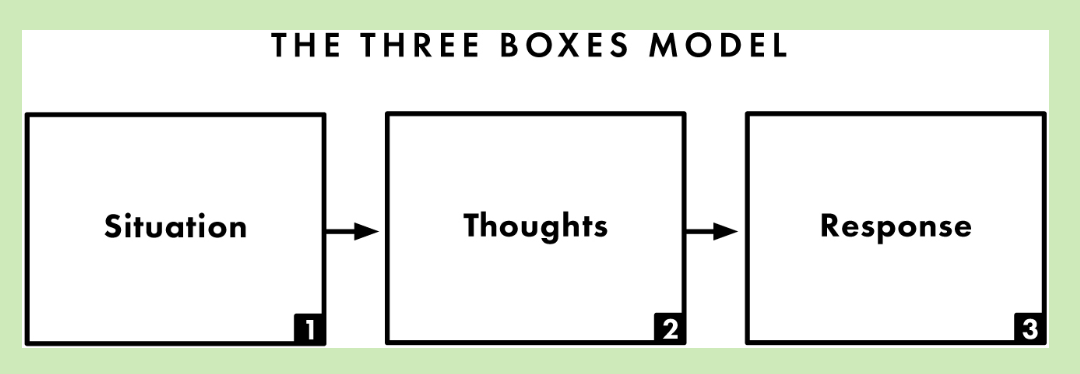
Her prescription is straightforward: if you intervene at the very beginning and “Change Your Situation” into a “Better Situation” (Box 1), you bypass the struggle of willpower and automatically trigger “Better Thoughts” (Box 2) and a “Better Response” (Box 3). Want to quit smoking? Put the cigarettes in another room—out of sight, out of mind. Struggling with smartphone addiction? Do the exact same thing.
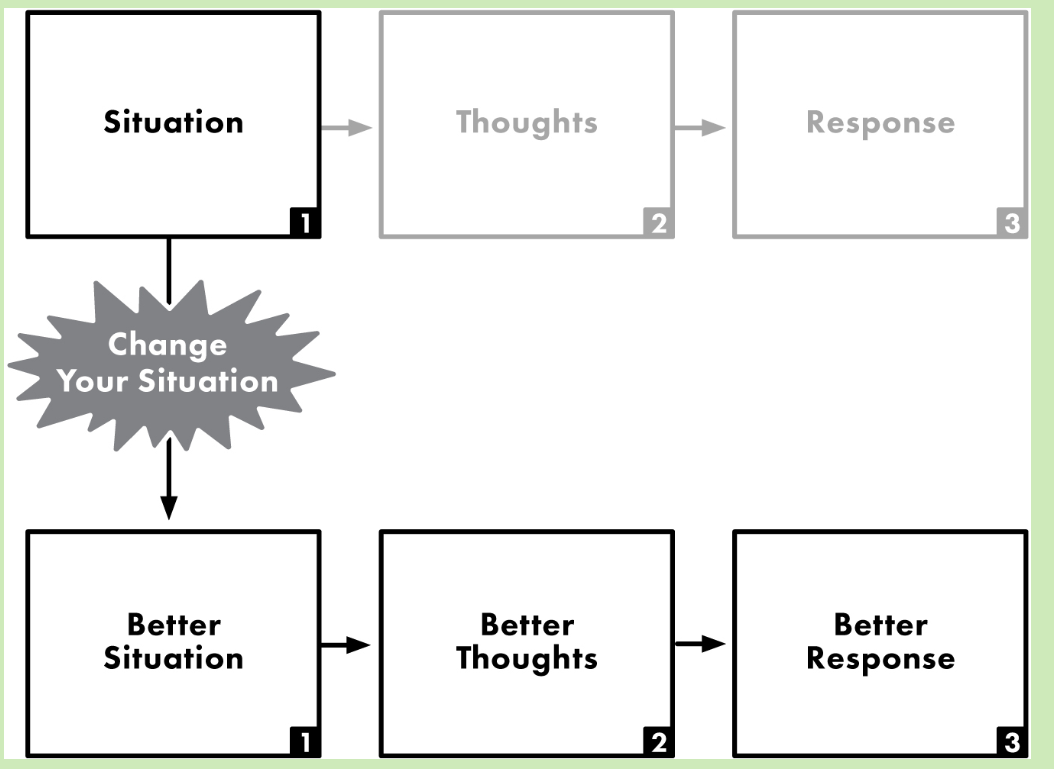
Is human behavior really that linear? Hardly.
I once worked with a family whose 14-year-old son was severely addicted to his phone. Following the exact logic of “changing the situation,” his parents made a deal with him: at 10 p.m. every night, he would leave his phone in the living room, go to his bedroom to sleep, and pick it up at 8 a.m. the next morning. The boy agreed—and then repeatedly failed to control himself.
Why didn’t changing the first box automatically fix the second and third boxes? Because the problem goes much deeper than physical distance. Once that 14-year-old put his phone down and walked into his bedroom, he stepped into a vacuum—he had no idea what to do with himself. Overcoming an addiction like that requires parents to engage with their child consistently over time, guiding him and helping him build new habits capable of replacing the screen. Simply moving a device into another room doesn’t even scratch the surface.
More importantly, Duckworth’s Three Boxes Model is linear, one-directional: Situation dictates Thoughts, and Thoughts dictate Response. In my perspective, however, human interaction with the world in reality is a continuous bidirectional loop. In other words, our thoughts are shaped by our environment, and in turn, they help shape our reality:
① Our internal thoughts and mental models interpret the situation first, which then shapes our response.
② Faced with the exact same situation, different internal models will extract entirely different meanings and choose different responses.
③ Those responses then reshape the situation in the next round, generating new feedback.
This is also why her linear model cannot explain one of the most common features of real life: relapse and recurrence.
Back in July, I suffered a severe lumbar disc herniation that left me completely bedridden—unable to sit or stand—for nearly a month before I recovered. Last week, while helping someone carry my mother in her wheelchair down a step, I bore over 110 pounds of weight, and my lower back flared up again.
According to Duckworth’s linear logic, once you optimize your situation, the problem should be solved for good. But in real life, complex problems recur. Getting better rarely happens in a single straight line; it requires going through repeated cycles of relapse and correction, another setback and another calibration. Fortunately, because I had spent my first recovery calibrating my internal model to my body’s signals, I now understood the pattern of my back injury. This time, after just one day of strict bed rest, I was able to start taking walks again within two or three days. What saved me wasn’t buying a better chair—or refusing to carry my mother. It was the dynamic loop of observing, interpreting, calibrating, acting, and learning from feedback.
4. Grit Isn’t Enough. Situation Isn’t Enough Either.
The central message of Duckworth’s new book is that grit is not enough.
The reality is that situation is not enough either.
In today’s fast-changing, deeply complex world, anyone hoping to achieve success, happiness, or longevity solely through the playbook in Situated is likely to hit a wall. Real outcomes are shaped by a vast web of interacting variables—environment matters, and willpower matters, but so do genetics, family background, life history, sustained effort, and sheer, uncontrollable luck.
Environments do shape behavior, but environments themselves are constantly in flux. Understanding our relationship with reality requires dynamic, cyclical thinking—not a one-way row of boxes. When reality refuses to cooperate, what carries us forward is not the luxury of shopping for a better situation. It is the capacity to see the gap between what we expect and what is, and to keep calibrating how we engage with reality as it unfolds.